
The Court Registry Investment System: The Financial Architecture of the Commercial Fraud
A Statement from Operation Wisedome
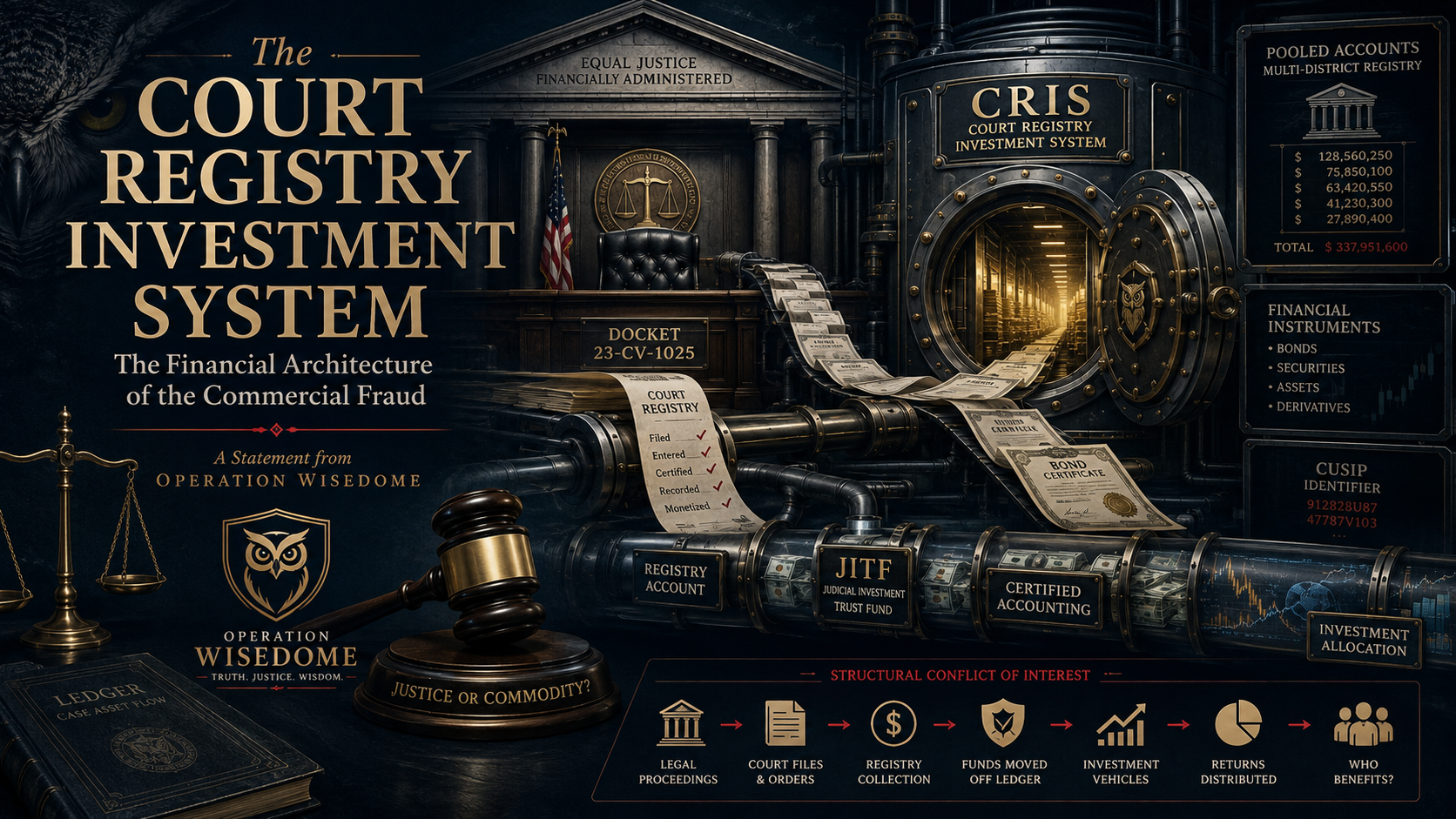
The Court Registry Investment System (CRIS) and the Judiciary Information Technology Fund (JITF) are not administrative conveniences. They are the operational pipeline through which private capital—extracted from the living men and women who appear in these corporate tribunals—is pooled into commercial investment accounts and converted into government technology, institutional revenue, and investable securities. This is not a legal argument. This is a structural conflict of interest that they have spent decades legalizing through their own rulings.
Every filing fee, every fine, every bond forfeiture, every child support payment, every asset division, every performance bond placed into the court registry does not sit dormant. It is pooled. It is invested. It generates yield. The court is not holding your money in trust—it is capitalizing on your conflict. The longer the case remains active, the longer the funds remain in the Registry. The longer the funds remain in the Registry, the greater the return. The court has a direct, undisclosed financial incentive to prolong litigation, to deny resolution, to manufacture controversy, and to keep the living man entangled in the commercial matrix.
This is the identical mechanism we have documented throughout the Operation Wisedome process:
The citation is a commercial presentment. The docket number is the bond identifier. The CUSIP links the case to the Tax-Exempt Bond Fund. The court form is an accounting ledger. The judge is the trust administrator. The clerk is the accountant. The All-Caps Name (ens legis) is the account holder. And the CRIS is the vault.
The only difference between the traffic court and the family court is the species of capital being harvested. In traffic court, it is fines, forfeitures, and surety bonds. In family court, it is child support, alimony, asset divisions, and performance bonds. The mechanism is identical: the living man is tricked into acting as the surety for the corporate fiction’s debt, the funds are pooled into the Registry, the Registry invests the capital, and the judiciary operates as a for-profit investment bank disguised as a court of law.
The Structural Conflict of Interest
Under 28 U.S.C. § 455, a judge must disqualify himself in any proceeding in which his impartiality might reasonably be questioned, or where he has a financial interest in the subject matter in controversy or in a party to the proceeding. The CRIS creates an institutional financial interest in every case that passes through the court. The judge is not a neutral arbiter—he is a fiduciary of the investment fund that profits from the continuation of the dispute before him. This is not a theoretical conflict. This is a structural, institutional, mathematically provable conflict of interest embedded in the architecture of the court system itself.
When you demand the certified accounting—when you demand the charging instruments from the Director of Finance—when you demand the CUSIP number associated with the case—you are not making a legal argument. You are exposing a structural conflict of interest that they have spent decades insulating from public scrutiny through their own self-serving rulings.
The Wisedome Response
The reform movements that focus on Parental Rights, Equal Time, and custody outcomes are fighting the symptoms. They are arguing within the commercial matrix, accepting the court’s presumed jurisdiction, consenting to the surety role, and begging for a favorable accounting entry. They will never win because the system is not designed to produce justice—it is designed to produce yield.
The Operation Wisedome response is different:
First, we do not argue the merits of the case within their colorable jurisdiction. We appear as the fiduciary and principal auditor. We demand the certified accounting. We demand the CRIS account records. We demand the investment returns generated from the funds held in the Registry under the case number.
Second, we file the Motion for Judicial Recusal based on the undisclosed security interest. The judge cannot preside over a case in which the court itself has a financial stake in the outcome. This is not discretionary—it is mandatory under 28 U.S.C. § 455.
Third, we demand the bonding and underwriting. Bonding and underwriting does not cover fraud. When the court fails to produce the accounting, when the court fails to disclose the CRIS investment records, when the court fails to identify the secondary obligor—the case must be dismissed because the bonding company will not indemnify a fraudulent proceeding.
Fourth, we file the IRS 1099 reporting. The investment income generated from the CRIS account is taxable. If the court is generating investment returns from the funds held under the case number, those returns must be reported. If they are not reported, the responsible fiduciaries are in violation of 26 U.S.C. § 7201 (tax evasion) and 26 U.S.C. § 7206 (fraud and false statements).
Fifth, we perfect the commercial default. When the court, the clerk, the judge, and the Director of Finance fail to produce the certified accounting, fail to disclose the CRIS records, and fail to rebut the sworn affidavit demanding identification of the financial interest—they enter into irrevocable commercial default. The unrebutted affidavit stands as truth in commerce. The default is perfected. The lien is filed. The bond is liquidated.
The Truth
court is not a court. It is a bank. The docket is not a docket. It is an investment account. The case number is not a case number. It is a CUSIP identifier. The judge is not a judge. He is a trust administrator with a financial interest in the outcome. The clerk is not a clerk. She is an accountant managing the Registry. The All-Caps Name is not you. It is the account holder—the corporate fiction through which the capital flows.
You are the living man. You are the living woman. You are endowed by your Creator with unalienable rights. You are not the surety. You are not the debtor. You are not the trustee. You are the Principal. You are the Secured Party Creditor. And when you know this—when you truly know this—the entire commercial matrix collapses, because it cannot function without your unknowing consent.
Qui tacet consentire videtur — He who is silent is deemed to consent.
But silence born of ignorance is not consent. And once the truth is known, the silence ends.
Operation Wisedome
Power Inherent in the People
